How to Choose the Right 15-Gauge Grip Glove for Your Workshop
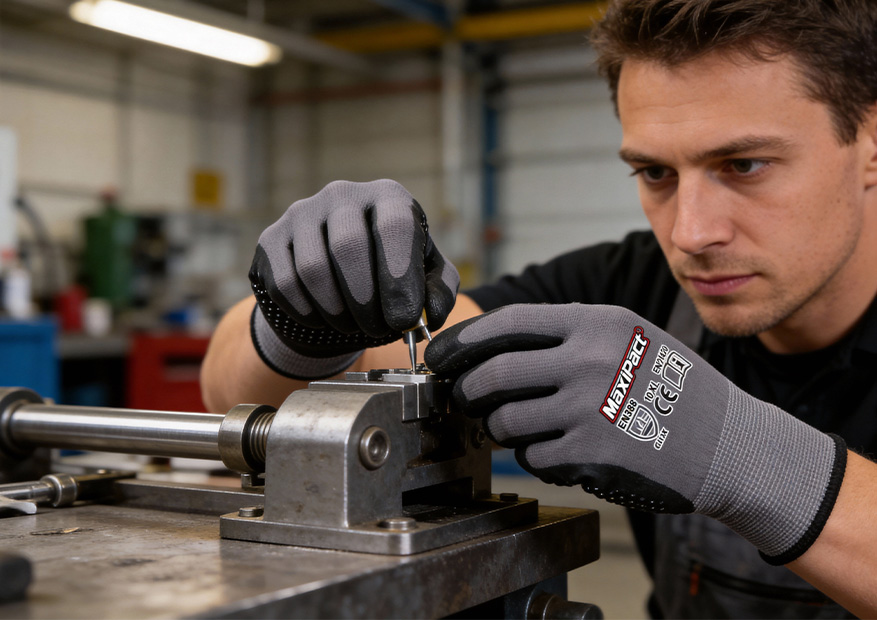
A few years ago, a costly lesson completely changed my perspective on “small gloves.” A skilled technician, while assembling precision parts, suffered scratches on the surface of the parts due to his glove slipping, resulting in tens of thousands of yuan in losses. Since then, I’ve understood one thing: for modern workshops, gloves are no longer simple work safety items, but precision production tools related to efficiency, cost, and safety. And the choice of tools must be based on scientific understanding.
Today, I want to delve into a seemingly basic yet crucial parameter from a user’s perspective: “15-Gauge.”
The Truth About “Gauge”: More Than Just Thickness, It’s About Structural Density
In the glove industry, “Gauge” is far more than just “thickness” or “needle count.” It’s a precise textile term referring to the number of needles on the needle bed per inch of length. Simply put, 15-Gauge means there are 15 needles involved in the weaving per inch. This number directly determines the fineness of the yarn, the tightness of the fabric structure, and the performance of the final glove.
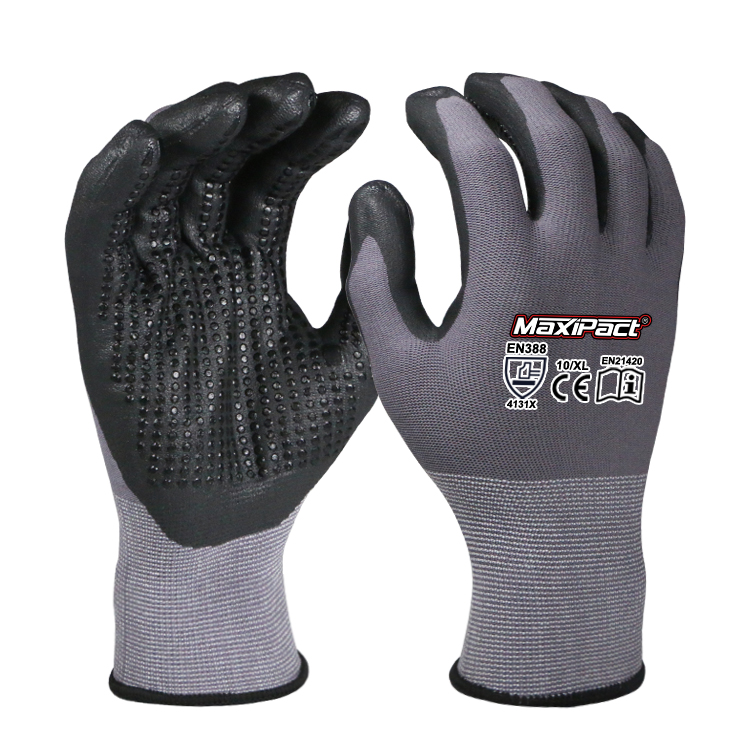
From a materials science perspective: Typically, 15-gauge gloves use fine yarns (approximately 210-280 denier in diameter) such as high-strength nylon, polyester, or blends. This fine yarn, combined with high-density weaving, produces unique physical properties. The tighter arrangement of fibers significantly reduces stretching and deformation under stress, providing more stable and “faithful” hand feedback. In contrast, common 13-gauge gloves have a looser structure, are more prone to deformation during repeated gripping, leading to a gradual blurring of the feel for the hand; while 18-gauge gloves, although finer, may have a weakness in resistance to oil and abrasion in heavy industrial settings.
Data Comparison Analysis: From a key performance perspective, the 15-gauge structure achieves the generally accepted optimal balance between protection, flexibility, and durability. Based on multiple industry tests (such as those based on EN 388:2016), typical 15-needle gloves demonstrate robust performance in abrasion resistance (level 3-4) and cut resistance (level 2-3). Their fabric structure effectively disperses shear forces while maintaining excellent tactile sensitivity, allowing for stable gripping of screws as small as M4 or thin parts.
Grip Principle: High-performance grip often relies on a PU (polyurethane) or nitrile rubber coating on the palm area. The high-density flatness of the 15-needle substrate provides the perfect “canvas” for the coating. Tiny coating dots adhere more evenly and firmly to each knit node, forming tens of thousands of micro-suction cups. This structure minimizes the risk of slippage when contacting smooth metal or plastic surfaces by increasing the effective contact area and intermolecular forces (van der Waals forces). In contrast, on loosely woven fabrics, the coating tends to flake, peel easily, and have a rough, grainy feel, affecting the grip.
Let me share an internal data tracking case from our workshop. After upgrading the gloves on a certain assembly line from general-purpose cotton gloves to professional 15-gauge gloves with PU dot coating, we conducted a three-month observation period:
The Performance Multiplier: Advanced Materials & Coatings
Efficiency Indicators: Average assembly time for precision components decreased by approximately 8%, primarily attributed to increased operator confidence and fewer adjustments due to glove slippage.
Quality Indicators: The scrap rate for minor scratches or stains from sweat and oil on component surfaces due to improper handling decreased by 15%.
Cost and Safety Indicators: Daily wear rate of gloves decreased by 40% due to their enhanced abrasion resistance. More importantly, near-miss incident reports related to hand fatigue and object slippage decreased.
This is not an isolated case. In fields such as automotive parts, electronic assembly, and small equipment repair, 15-pin grip gloves have become the default “standard configuration” for many experienced production managers. It addresses not only the issue of “cut protection,” but also the systemic issue of “precise, efficient, and labor-saving work completion.”
How to make an informed choice for your team?
Faced with a dazzling array of products on the market, how should a shop floor manager make decisions? Here are some checkpoints based on technical parameters:
Verify core standards: Ensure gloves comply with relevant standards such as EN 388 (protection against mechanical hazards) or ANSI/ISEA 105 (US standard), and pay attention to specific abrasion resistance and cut resistance ratings.
Clarify coating and substrate combination: Based on whether the primary contact object is a dry part, slightly oily, or in a humid environment, choose a coating of PU (excellent grip in both dry and wet conditions), nitrile (stronger oil resistance), or latex (good comfort and elasticity).
Focus on ergonomic design: The curved weave at the finger bends, the breathable area on the back of the hand, and the fit design at the wrist—these details significantly affect comfort and fatigue during up to 8 hours of wear.
Conduct small-scale trial runs: Conduct trials on processes that best represent actual working conditions, collect feedback from frontline operators, and use simple efficiency and wear data to demonstrate the effectiveness.
Investing in the right hand protection solution yields returns far beyond reducing the unit price on the procurement list. It manifests in smooth production line operation, consistent improvement in product quality, and most importantly, in every employee’s still nimble and healthy hands when they leave work. In this era of pursuing lean manufacturing, perhaps the secret to enhancing competitiveness lies in every carefully designed pair of gloves.