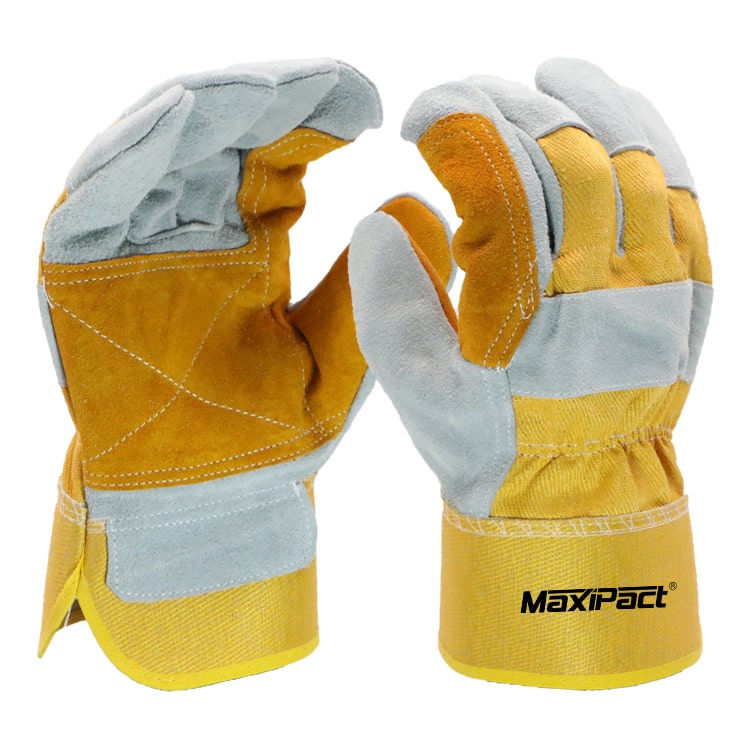
Reinforced Palm Cow Split Leather Gloves
80-300 GY


FEATURES

Grip

Anti Wear
APPLICATION

Metal

Construction

Landscape

Lumber
-
Palm Material: Select split cowhide leather
-
Back Material: Canvas
-
Size: 9-12 Inch
-
Package: 12 Pairs/Polybag
-
Different Color Available
-
Cuffs completely cover the wrist, preventing splashes, debris or other materials from getting inside.
-
Split cowhide has good abrasion resistance, durability and puncture resistance, providing reliable protection.
-
Thickened cowhide resists mechanical friction and wear, providing reliable protection for hands.
-
Reinforced palm provides better resistance to abrasion.
-
Canvas material is strong and breathable.
Follow us on Facebook
A: What is the normal service life of gloves?
Q: Depends on usage environment and frequency. Disposable: single-use only. Regular work gloves: replace every 3-6 months. High-grade gloves (e.g., cut-resistant): ~1-3 months under daily heavy use. Final replacement timing depends on actual wear condition.
A: How should gloves be properly stored?
Q: Store in a cool, dry, ventilated place, away from direct sunlight and heat sources (e.g., radiators); keep away from ozone sources (e.g., motors, high-voltage equipment); avoid mixing with corrosive chemicals; hang or lay flat to prevent deformation; periodically check stock condition.
A: Which job types are best suited for leather gloves?
Q: Leather gloves are particularly suitable for: ① Welding & foundry (heat-resistant, spark-resistant); ② Construction & demolition (abrasion-resistant, puncture-resistant); ③ Glass & metal fabrication (cut-resistant, abrasion protection); ④ Fire & rescue (durable, heat-resistant); ⑤ Driving & transport (comfortable, vibration-damping). For wet or oily environments, choose oil-tanned pigskin gloves; for precision work, opt for thin goatskin gloves.
A: How can proper maintenance extend glove service life?
Q: ① Clean before and after use to remove surface dirt; ② Avoid using beyond rated temperature/intensity limits; ③ Rotate multiple pairs to allow recovery time; ④ Store properly to avoid compression/deformation; ⑤ Regular inspections — minor damage should be repaired or replaced promptly to prevent worsening.