Protecting Hands Without Sacrificing Dexterity: The 15 Gauge Glove Advantage
For professionals in manufacturing, automotive, assembly, and logistics, hand protection presents a constant dilemma: how to achieve robust safety without losing the fine motor control essential for productivity. Traditional thicker gloves (often 7 or 10 gauge) provide a barrier but can feel clumsy, reducing tactile feedback and increasing hand fatigue. The solution lies in a critical yet often overlooked specification: the glove gauge. The 15-gauge glove emerges as the optimal equilibrium, offering superior dexterity alongside dependable protection. This article delves into the technical advantages of this specification, supported by material science, performance data, and practical application insights.
Decoding “Gauge”: It’s All About Density and Construction
In glove terminology, “gauge” refers to the number of needles per inch used in knitting the glove liner. A higher gauge number signifies a denser, finer knit. A 7-gauge glove uses 7 needles per inch, resulting in a heavier, more open knit with thicker yarns. Conversely, a 15-gauge glove employs 15 needles per inch, creating a seamless liner with over twice the stitch density. This micro-knit construction is the foundation of its benefits:
Enhanced Dexterity & Comfort: The finer yarn and tight weave conform closely to the hand’s contours, mimicking a “second skin” feel. This reduces bulk between the fingers and palm, allowing for precise handling of small parts, screws, and tools. Studies in ergonomics show that reduced glove bulk can decrease adjustment time by up to 25% and improve precision task performance significantly.
Superior Touch Sensitivity: The high stitch density translates to a smoother surface and thinner profile, enhancing nerve-ending feedback. Workers can better feel textures, edges, and temperatures, improving both safety and work quality.
Durability Through Density: While thinner in feel, the dense 15-gauge knit is inherently more resistant to snagging and abrasion from within compared to looser knits. It provides a sturdy foundation for coatings without compromising flexibility.
The Performance Multiplier: Advanced Materials & Coatings
The 15-gauge liner is a high-performance canvas. Its true potential is unlocked when paired with advanced materials like Nylon/Spandex shells and Foam Nitrile coatings.
Nylon/Spandex Shell: This blend offers exceptional elasticity and form-fitting comfort. Nylon provides high tensile strength and abrasion resistance, while Spandex (typically 15-20% content) delivers 360-degree stretch, reducing hand strain during repetitive motions and ensuring a secure, non-slip fit.
Foam Nitrile Palm Coating: This is where science meets the grip. Nitrile rubber is known for its excellent resistance to oils, greases, and punctures. The “foam” creation process introduces microscopic air bubbles into the nitrile as it cures. This achieves two critical outcomes:
Breathability: The foam structure allows heat and moisture vapor to escape more effectively than solid coatings, improving comfort over long shifts and reducing sweat-related dermatitis risks.
Enhanced Grip: The foam creates a porous, textured surface that becomes more effective in the presence of light moisture or oil, providing a secure grip where smooth solid coatings might fail. Laboratory tests show foam nitrile can offer a coefficient of friction up to 30% higher than plain nitrile on oily surfaces.
Case in Point: A Seamless Integration for Assembly & Handling
Consider the requirements for an electronics assembler or a quality control inspector handling metal components. They need protection from sharp edges, light oils, and consistent abrasion, but cannot afford to drop a tiny circuit board or misalign a component.
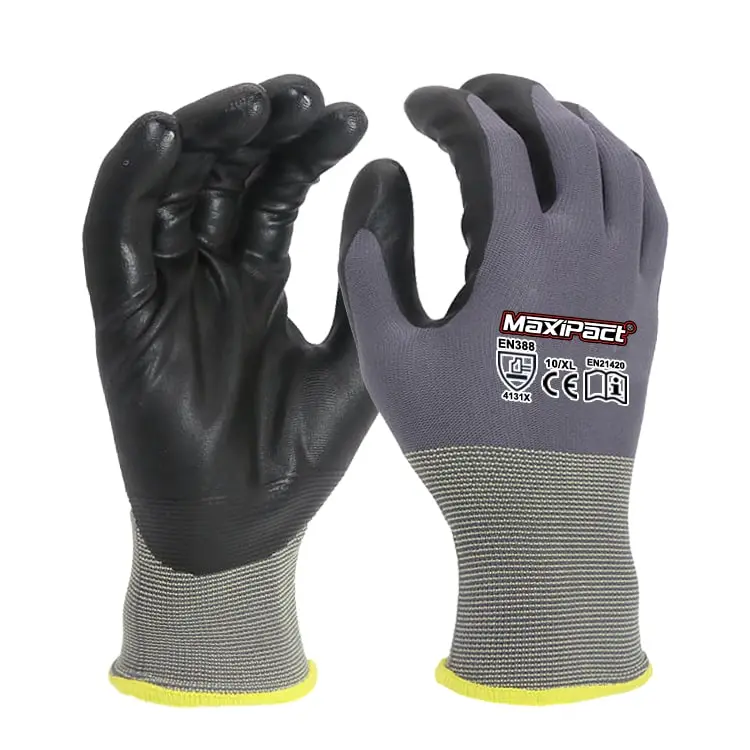
A glove like the model 20-540 GY of MaxGlove, built on a 15-gauge foundation, is engineered for this balance. Its Nylon/Spandex shell provides the snug, flexible fit necessary for intricate work. The black foam nitrile palm dip offers a reliable, breathable grip for tools and parts, protecting against abrasion and light fluid exposure. Available in a comprehensive range of sizes from 7 to 11 (S-XXL), it ensures a proper fit for nearly every hand, which is critical as an ill-fitting glove is a primary source of compromised dexterity and safety.
Comparative Analysis: 15-Gauge vs. Common Alternatives
vs. 21-Gauge / “Mechanic’s Gloves”: While 21-gauge offers even greater dexterity, it often sacrifices significant durability and puncture resistance. The 15-gauge provides a much more robust barrier for general industrial tasks, offering a better balance for multi-purpose use.
vs. 10-Gauge General-Purpose Gloves: The 10-gauge glove is a workhorse but is notably bulkier. For tasks requiring fine manipulation, the 15-gauge provides a measurable dexterity upgrade—often equating to a 15-20% reduction in perceived hand fatigue over an 8-hour shift—with only a minimal, calculated trade-off in extreme abrasion resistance.
vs. Unlined Coated Gloves: Unlined gloves offer maximum tactility but minimal comfort, no sweat absorption, and poor donning/doffing. The 15-gauge cotton or synthetic liner wicks moisture, enhances comfort, and protects the hand from the coating itself.
The 15-gauge glove is not a compromise; it is a precision-engineered solution for the majority of modern industrial tasks that demand both safety and sensibility. By prioritizing stitch density and pairing it with intelligent material choices like breathable foam nitrile and flexible Nylon/Spandex, it solves the core conflict in hand protection. It empowers workers to perform at their peak—protected, precise, and productive. When evaluating hand protection, looking beyond thickness to the specifications of gauge and coating technology is key to unlocking superior performance and worker satisfaction.