What You Need to Know Before Buying Chemical Gloves
When Sarah Chen took over as safety director of a chemical plant with 400 employees, her first inspection revealed a worrying problem. “I saw people wearing the same nitrile gloves they used when handling solvents as they used when handling acids,” she said. In her first month, she audited every workstation and found that nearly 60% of the gloves were the wrong type for the chemicals being handled. “This isn’t a worker problem—it’s a training and selection problem,” she said. Her experience reflects a broader reality: chemical protective glove selection is one of the most misunderstood areas of workplace safety, and choosing the wrong one can mean chemical burns, systemic absorption, or even more serious consequences.
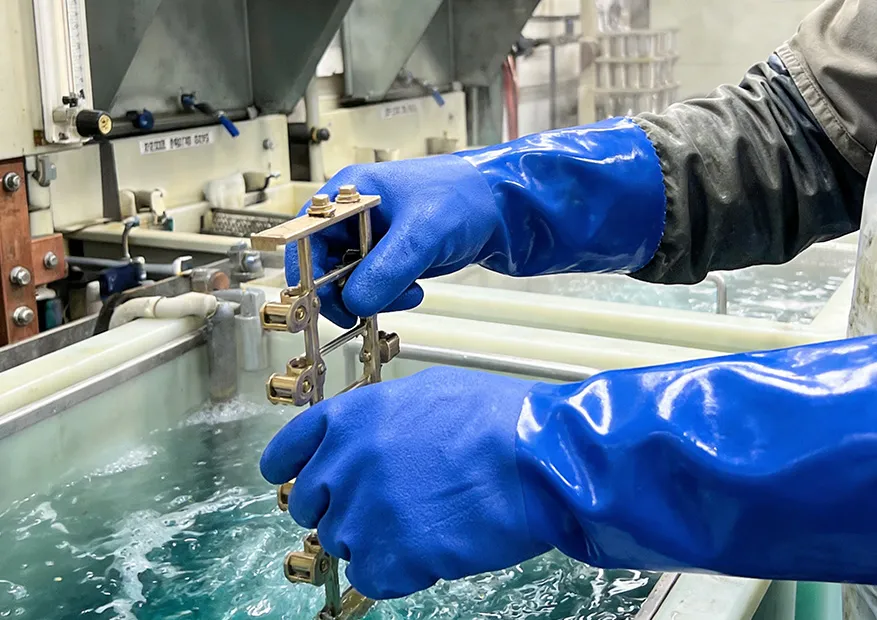
What many buyers don’t realize is that no single glove material protects against all chemicals. As the University of Ottawa’s glove guide demonstrates, a glove rated “Excellent” for one chemical may be “Poor” for another. For example, nitrile performs well against oils and greases but poorly against ketones like acetone. Neoprene excels with acids and bases but struggles against halogenated hydrocarbons. This material-specific behavior is why a one-size-fits-all approach to chemical gloves is fundamentally flawed.
The Science Behind Glove Performance
The most critical metric in chemical glove selection is permeation breakthrough time—how long it takes a chemical to travel through the glove material and reach the skin. This is measured under standard conditions and classified into six performance levels under EN ISO 374:2016. Level 6 indicates a breakthrough time greater than 480 minutes, offering the highest protection. Level 1 represents minimal resistance.
But here’s the catch: breakthrough time should not be interpreted as total usage time. It’s a comparative tool for distinguishing between glove materials, not a guarantee of how long you can safely wear the glove. Factors like temperature, chemical concentration, and repeated flexing can all accelerate permeation.
The Other Half of the Story
Permeation is only part of the equation. Degradation refers to physical changes in the glove material when exposed to chemicals—swelling, hardening, cracking, or discoloration. A glove can fail through degradation even before permeation occurs. According to a comprehensive study on polymeric gloves exposed to methanol, different glove materials respond differently to chemical exposure: some become harder and more brittle, while others swell and soften. Either outcome compromises protection.
The study also found that SEM imaging revealed micro-cracks in glove surfaces and cross-sections after prolonged exposure, indicating that chemical damage may not always be visible to the naked eye. This is a critical point: a glove that looks fine may have already lost its protective integrity.
Matching Glove Materials to Chemicals
Common Materials and Their Strengths
Nitrile is arguably the most versatile chemical-resistant glove material. It offers excellent protection against oils, greases, solvents like acetone, and mild acids and bases. It’s also puncture- and abrasion-resistant, making it suitable for tasks that combine chemical exposure with mechanical risks. However, nitrile should be avoided when handling ketones like methyl ethyl ketone (MEK) or chlorinated solvents, as these will degrade the material.
Neoprene provides strong resistance to acids, bases, alcohols, and petroleum products. It maintains flexibility even in challenging conditions and resists ozone and weathering. Its weakness lies with halogenated hydrocarbons such as chloroform.
Butyl rubber excels against ketones, esters, and strong acids. It offers superior gas and water vapor resistance, making it ideal for environments with volatile chemicals. But it performs poorly with aliphatic or aromatic hydrocarbons.
Latex (natural rubber) works well with water-based solutions, alkalis, and alcohols, but it offers little protection against oils and organic solvents. Latex allergies are also a significant concern, leading many facilities to phase it out in favor of alternatives.
PVC gloves resist acids, bases, oils, and fats, but stiffen in cold environments and perform poorly against most organic solvents.
What to Consider Before Buying
Before selecting gloves, safety director Chen recommends a thorough inventory of every chemical used at your facility. “List the chemicals, their concentrations, the temperature they’re handled at, and how long skin contact might last,” she advises. This inventory becomes the foundation for every subsequent decision.
Assess Frequency and Duration of Contact
Is the worker occasionally splashed, or are hands immersed in chemicals for extended periods? The answer dictates whether a thinner, more dexterous disposable glove suffices or a thicker, reusable glove is required. According to Western Carolina University’s safety guidelines, disposable gloves are adequate for incidental chemical contact but must be replaced immediately after contamination.
Consider Dexterity Requirements
Some chemical gloves are thick and bulky to maximize protection, but this comes at the cost of dexterity. If the task involves handling small parts, using fine tools, or performing precision work, the gloves must allow sufficient tactile feedback. In such cases, the ideal glove balances protection and dexterity rather than maximizing one at the expense of the other.
Watch for Multi-Hazard Scenarios
Workers often face more than just chemical exposure. Sharp edges, abrasive surfaces, and electrostatic discharge hazards can coexist with chemical risks. A common mistake is selecting gloves solely based on chemical resistance while ignoring these other threats. Some workers resort to double-gloving—wearing chemical gloves under cut-resistant gloves—but this can reduce dexterity so much that workers remove one or both layers, defeating the purpose. Look for chemical-resistant gloves that also meet EN 388 mechanical protection standards for abrasion, cut, tear, and puncture resistance when multi-hazard protection is needed.
Inspection and Replacement
Before each use, gloves should be inspected for discoloration, punctures, tears, or signs of degradation—flaking, swelling, or texture changes. However, as the methanol exposure study demonstrated, chemical damage can occur at a microscopic level without visible signs. Reusable chemical gloves have a prescribed lifetime based on the manufacturer’s testing, and they should be discarded when that lifetime expires—even if they appear intact.
Choosing chemical gloves isn’t about picking the most expensive pair or the thickest material. It’s about matching the glove’s specific resistance profile to the actual chemicals and conditions of the job. Start with a chemical inventory. Consult the manufacturer’s permeation and degradation data. Match the material to the hazard. Consider dexterity, duration, and secondary risks. And remember—as Sarah Chen emphasizes to every new hire in her plant—”The right glove on the wrong chemical is the same as no glove at all.” When you take the time to make the right choice, you’re not just protecting workers from chemicals—you’re protecting them from a false sense of security.
With years of experience in manufacturing chemical protective gloves and hand protection products, MaxGlove offers customized selection solutions based on different chemical types, exposure durations, and operating scenarios, helping businesses and individuals find the right protective gloves.